Without Grace And Running

Taking a closer look at the hidden costs of velocity.
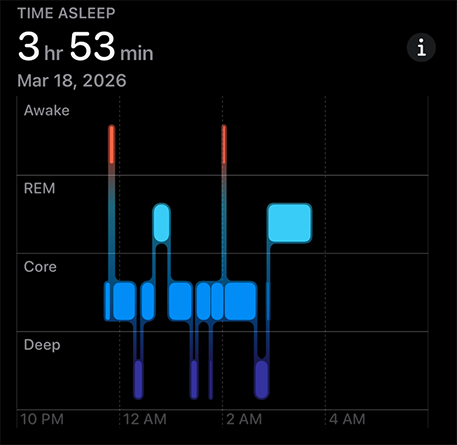
In my very first post I acknowledged one of the more unfortunate impacts of my Eye•Full project: it was impacting my sleep. As the project advanced, I was spending more and more time trying to work through strategies or prompt details that would allow me to maintain some control over the outcome. I talked about wanting to "trick the agent" into giving me the results I wanted. Part of that came from the anxiety of working with systems that I did not understand. But it also came from the residue built up from monitoring the outcomes that strayed from what I wanted. With each iteration, a growing film of distrust increased the need for scrutiny of the agent and its output.
Looking back, it seemed like an early step on the path to "AI brain fry", described in this paper as the “mental fatigue that results from excessive use of, interaction with, and/or oversight of AI tools beyond one's cognitive capacity.” In an inversion of surveillance fatigue, where people experience exhaustion from the knowledge they are constantly being watched, I started to experience the burden of being the watcher. Were interactions working as expected? Were animations presenting like I imagined? Was the layout consistent across screens? While the AI could claim some superficial allegiance to these values, I was the one who needed to maintain them.
My usage of AI tools was not especially sophisticated. I was not trying to orchestrate, and monitor the output of, multiple agents. But I did start to see sessions extend to 12 hours or longer, long enough for the vigilance decrement, "the gradual decline in the ability to monitor the environment and detect rare but critical stimuli over time" to become a factor. And that fatigue is not the only risk. HBR also identified six types of psychological debt that "can degrade employee motivation, corrupt collaboration and innovation, and create higher levels of stress and burnout." Is it a surprise that polling data is showing that "majorities of both AI users, 60%, and non-users, 85%, say AI is a bad thing for society"?
As a designer, I definitely noticed the weight of that extra attention. Every agent response was fluent and confident. "I can see clearly what the issue is." It was a misdiagnosis. "This bug has been fixed and the app is ready to ship!" The app was still broken. The burden of maintaining the integrity of the experience and the continuity of the design was all on me because the agent had no real stake in the effort. It could be confidently wrong and suffer no consequences. As trust degraded, very output became an interrogation. Did that work as intended? Did that fix the issue? Is that actually what I meant to happen?
As my role in the process became skewed towards monitoring and auditing, even that became more difficult as the output and documentation piled up in the project. The pool of markdown files kept expanding and with it came questions about accuracy, obsolescence, and completeness. Some of it documented misdiagnoses and ineffective fixes. Some of it thoroughly described approaches that were no longer applied in the app itself. Some of it described solutions that fragmented across multiple files. The weight of monitoring as this library increased as time went on, requiring more horsepower to keep things moving, like a tractor pull.
My app was small and deliberately simple, but the documentation just kept sprawling. I quickly fell behind and was no longer able to identify what was true, relevant, and useful without significant effort. The agent never tired of creating more, adding to the burden of my role in the process. Trying to do this at scale in an enterprise environment doesn't sound like an empowering simplification of the work to me. It sounds like a recipe for being overwhelmed and disoriented.
Agentic coding doesn't make this any easier. Continuous low-level monitoring becomes high-stakes inspection with little, if any, understanding about how the results were generated. When something goes wrong, your role shifts to archaeologist, sifting through materials to try and understand an environment that you are not a part of. We surrender our agency and influence of the outcome to a machine that may or may not know better. And in that deference, we skip past opportunities to sharpen and expand our own skills.
Most significantly, we risk our own credibility. As Anna E. Cook notes on Bluesky, AI can never be held accountable, but we can. The burden of shipping bad code for unstable features falls on us.
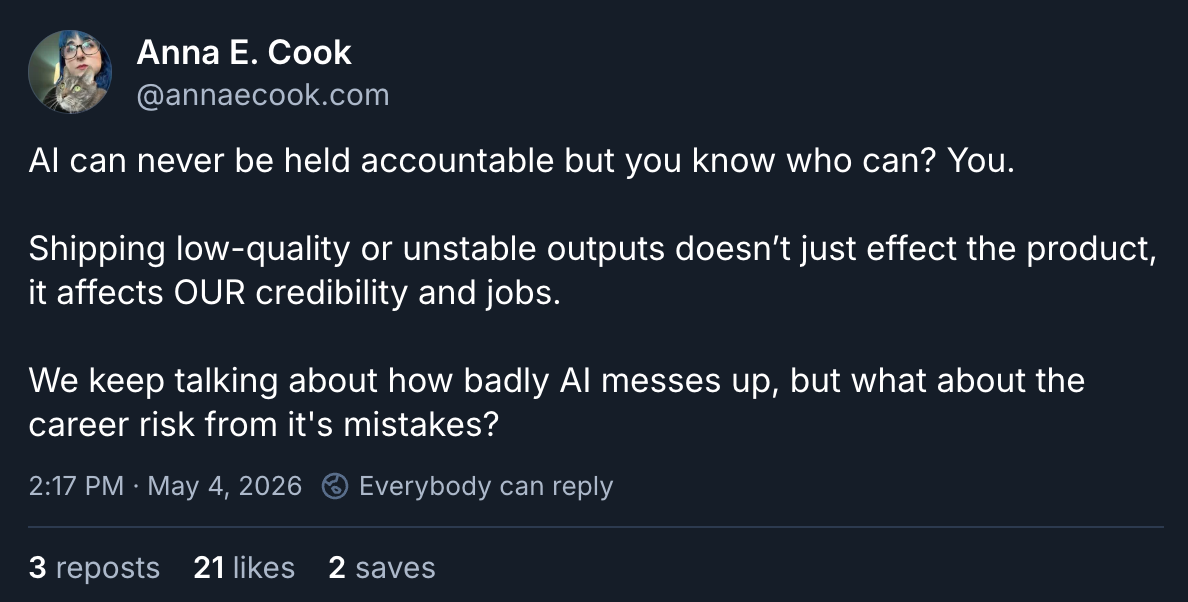
The AI agent will never be placed on a PIP or fired, but the same can't be said for the prompters. In a world of layoff anxiety, are we all frustrated typers now?

I don't see an obvious remedy for this. As things are, generative roles like designers are increasingly being marginalized into monitors and auditors surveying a machine's work. We're not even creating artifacts, we're QAing them. After years spent advocating for the ROI of design, I don't think that is the seat at the table we're looking for.
Note: The title of this post comes from the song In Speed by Faun Fables. If you are into weird, theatrical folk music, The Transit Rider is worth a listen.